
For many years I assumed memory worked like a filing cabinet. Experiences happened, were neatly stored away somewhere in the mind, and later could be retrieved just as they occurred.
Age has persuaded me otherwise. Memory is not a storage room. It is a conversation.
The faces of many men I served beside have become blurred. I have never forgotten the book carried by a man who died against us. One memory has remained with me for more than half a century.
Not because it was the bloodiest day of the Vietnam War.
It wasn’t.
Not because it was the most dangerous.
It wasn’t.
It remains because, only many years later, I began to understand what actually happened.
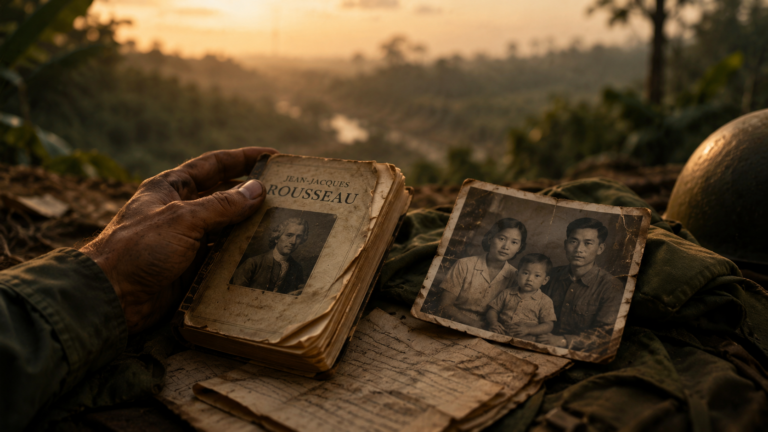
After one particularly vicious firefight, I was assigned the unpleasant but necessary task of searching the bodies of several North Vietnamese soldiers for anything our intelligence officers might find useful. Among the possessions of one young soldier was a photograph of his family—a wife and two small children.
That was not unusual.
Many soldiers, on both sides of the war, carried photographs of those they loved. I looked at it briefly before setting it aside.
Then I found something unexpected.
A book. Dog-eared and well worn.
It was written in French. I recognized the author’s name immediately.
Jean-Jacques Rousseau.
A couple of years earlier, I had read his Confessions. At that moment, I knew only one thing. The dead man and I had admired the same writer. That realization should have meant almost nothing.
Instead, it changed everything.
The photograph belonged to his family.
The book belonged to him.
Until that moment, he had belonged to a category.
Enemy.
North Vietnamese soldier.
One more casualty in a war already crowded with casualties.
The book quietly dismantled those categories.
I found myself wondering why Rousseau mattered to him. Had he struggled through the French text at his age the way I had struggled through the same book in English at mine? Had someone recommended it? Had he argued about its ideas with friends? Did he carry it because he loved it, or because he hoped someday to understand it better?
I have no answers to any of those questions.
I never will.
Yet those unanswered questions transformed him from an abstraction into a person.
The strange thing is that nothing about him had changed. Only my relationship to him had changed. That moment has stayed with me ever since. And not because I learned something about the dead soldier.
I learned something about myself. I realized how easily the human mind lives inside categories.
Enemy.
Foreigner.
Refugee.
Political opponent.
Rich.
Poor.
Successful.
Failure.
Categories are useful. They help us navigate a complicated world. But they also spare us the harder work of relationship.
Relationship begins the moment another human being refuses to remain a category.
I have often wondered whether the same lesson applies far beyond humanity. Much of our relationship with the natural world also begins with categories: resource, pest, weed, predator, game, property. Useful labels, perhaps—but labels nonetheless.
The moment relationship replaces category, our behavior changes. A forest is no longer merely timber. A wolf is no longer merely a threat. A river is no longer simply water waiting to be diverted. We begin to ask not only what these things are for, but what they are in themselves.
Perhaps that is why memory changes as we grow older. We often think memory fades.
I am no longer sure it does. Perhaps memory waits. Not for the past to change.
For us to change.
Perhaps only then can we finally see what was there all along.
The older I become, the less I remember events. The more I remember relationships. That distinction has shaped much of what I have written in The Stillness Series.
The novels begin with categories.
Humans and Superior Ones.
Enemies and allies.
The familiar and the alien.
Each seems clearly defined.
Yet as the story unfolds, those categories slowly dissolve. Individuals emerge. Enemies become companions. Monsters become tragic figures. Even those who appear most alien reveal longings, doubts, failures, and hopes that cannot be contained by a single label.
Perhaps that is true outside fiction as well. Perhaps the greatest transformations in our lives do not occur when the world changes. Perhaps they occur when relationship quietly replaces category.
Looking back now, I sometimes think the most important thing I carried home from Vietnam was not a memory of war.
It was a French book found in the pocket of a man I had been taught to call my enemy.
Sometimes the shortest bridge between two enemies is something as simple as a book.