
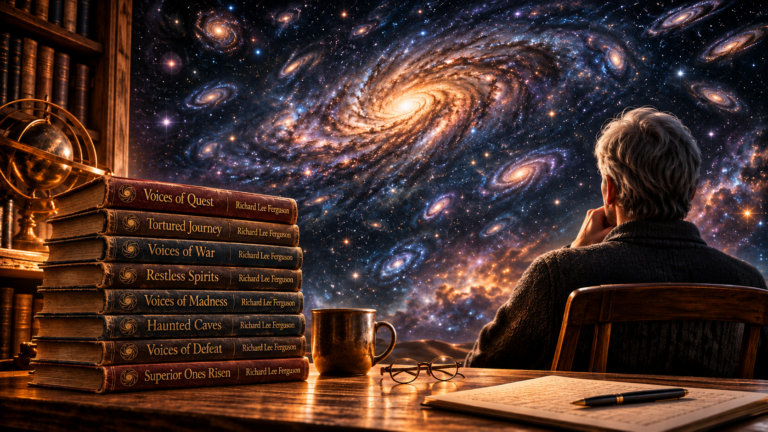
A million seconds is about twelve days. A billion seconds is nearly thirty-two years. A trillion seconds is almost thirty-two thousand years.
I can understand twelve days. I have lived through more than two billion seconds, although I would have preferred not to learn that just now. Thirty-two thousand years is harder. I can write the number, but writing it does not mean I have adequately imagined it.
Now consider an estimate that there may be two trillion galaxies in the observable universe. If you counted one galaxy every second, you would need more than sixty-three thousand years to finish. No sleep, no meals, no stopping to examine whatever you had just counted. Each second would dispose of an entire galaxy, with its stars and whatever else might be going on around them.
I have written ten books.
They make up The Stillness Series, an undertaking that has occupied more than a billion seconds of my life—and counting. That is about thirty-two years, against the roughly sixty-three thousand I would need to count the galaxies.
I have thought about these books while doing other things, returned to passages I thought were finished, and argued with myself over words that no one else was likely to notice. My wife has read the manuscripts and found reasons for me to return to them again. Meanwhile, the galaxies have continued without requesting a progress report.
There is something embarrassing about the comparison. Ten books on one side; two trillion galaxies on the other. Even before I have decided what is being measured, I feel that I have lost.
But why? When did size become a measure of worth?
A galaxy is larger than a dog. That does not make it better company. If your dog is suffering, a photograph of a distant galaxy will not persuade you that the suffering is too small to matter. You will attend to the animal in front of you. Few of us would consider that a failure to understand astronomy.
Yet we often look at the night sky and conclude that our smallness establishes our insignificance. The conclusion seems almost compulsory. We occupy very little space, exist for very little time, and therefore amount to very little. The measurements are physical. The verdict goes considerably further.
I doubt that increasing my readership would resolve the problem. A thousand readers would please me. A million would require some adjustment to my expectations. But even if every human alive read all ten books, the galaxies would remain as numerous and as uninvolved as before. There is no circulation figure at which a novel acquires appreciable cosmic dimensions.
Perhaps I am asking for the wrong kind of recognition.
A book happens between a writer and a reader. Someone who has never met me encounters a thought I spent years trying to express. The reader may reject it, misunderstand it, or recognize something I did not know I had put there. Whatever happens takes place within a very small portion of existence. So does a conversation with someone we love. I do not know how enlarging either event would improve it.
This question runs through The Stillness Series. Humanity is replaced. Existence continues beyond the species that has so often treated itself as the reason for everything else. Our achievements do not purchase a guarantee of permanence. Neither do our suffering, our intelligence, or our understandable wish to remain.
For a human writing books about humans and their successors, that is an awkward position. I have spent decades imagining lives whose larger circumstances challenge their importance. They still grieve. They still want things. They misunderstand one another and sometimes manage to understand enough.
My Last Human can confront possibilities far beyond human experience and still want Esméralda near him. The wider universe does not cure that desire. He is an animal who wants companionship, with sufficient self-awareness to find his need humiliating, though understanding it does nothing to diminish it.
I recognize the predicament.
There is a comforting argument available here: perhaps conscious creatures give the universe its meaning. The stars cannot appreciate themselves. We can appreciate them. Therefore, despite our size, we occupy a privileged place after all.
I am suspicious of how conveniently this restores us to prominence.
Why should a star need appreciation? Why should stone, water, or a galaxy require a witness before its existence becomes worthwhile? We have barely conceded that the universe does not revolve around us before appointing ourselves its justification.
Nonlife preceded us. It produced the conditions from which life emerged. I see no reason to regard that long existence as an empty preliminary to creatures capable of commenting on it. And if other forms of awareness succeed us, I doubt that their existence will require human approval either.
This leaves me without the reassurance I might reasonably have expected an essay about my books to provide. I cannot establish that they matter to the universe. I cannot establish that the universe needs things to matter. I would nevertheless like someone to read them.
Vanity is involved. So are affection, curiosity, habit, and the persistent feeling that there is something I have not quite managed to say. More than thirty years of writing have given me opportunities to examine my motives. They have not made those motives pure.
John Ruskin described a book as an author’s offering of the best of himself. For the rest, the writer ate, drank, slept, loved, and hated much as anyone else did. His life passed like vapor. But here was something he had seen and understood, something he thought might be worth another person’s memory.
Other than my family, this is the best of me. I have lived, observed, misunderstood, reconsidered, and tried to put some portion of that experience into these ten books. They contain things I could not have said when I began them. Whether those things deserve remembering is beyond my authority.
The galaxies offer no assistance. Their scale does not tell me whether a sentence is honest, whether I have understood a character, or whether a reader might find something worth considering. Those judgments remain close at hand, with all the uncertainty that makes them difficult.
I look again at the paragraph on my screen. My wife has pointed out that its last sentence is unclear.
She is right. I begin revising it.