
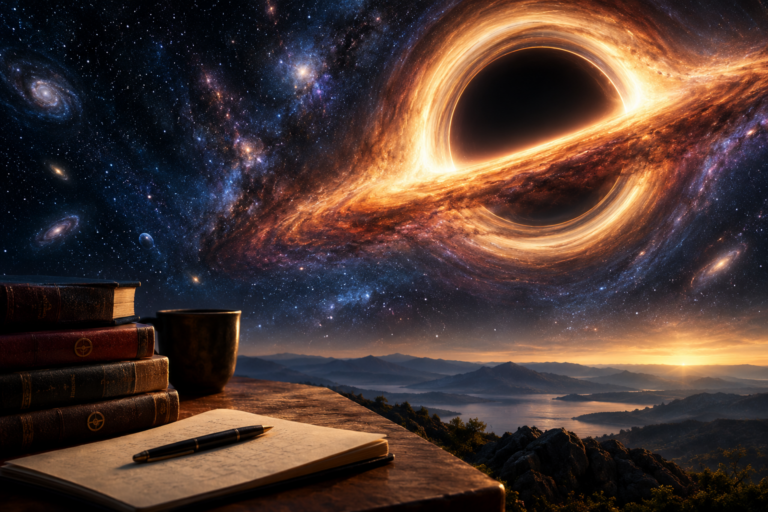
Lately, I have been considering the importance of The Stillness Series, the books I have spent decades writing. A handful of people have actually read them, which gives me some basis for claiming they matter to someone. (Harry Potter slightly exceeds my readership by several orders of magnitude, but I am trying not to take that personally.) From there, the inquiry widens: what importance does my life possess, or the planet on which I live, or the solar system that contains it? Each widening of the frame makes what once occupied the center seem less consequential.
The observable universe may contain roughly two trillion galaxies. The estimate is uncertain; the difficulty it presents to my vanity is not. Somewhere in that immensity is TON 618, a distant quasar powered by an extraordinarily massive black hole. Contemplating it makes the entire solar system seem like a modest arrangement.
TON 618 has apparently managed without The Stillness Series.
One response would be to insist that size does not determine importance. A book can matter to a reader. A life can matter to another life. I could develop that argument, arrive at a reassuring conclusion, and get back to work.
But I would already have begun ranking again.
Are my books more important than photosynthesis? Than a blue whale feeding? Than rock slowly becoming soil? By what measure? Their contribution to human culture? Their capacity to sustain life? Their duration? Their influence on something that will happen after I am gone?
Perhaps I am demanding too much. I tell myself I merely wanted to tell a story. That ought to settle it. It does not.
Change the measure and the order changes. Choose another measure and change it again. Eventually I discover a scale on which I amount to practically nothing. That is unpleasant, so I turn my attention to meaning. Perhaps I have confused importance with meaning. I define meaning, examine the definition, discover its limitations, and begin again.
But what makes meaning meaningful?
Then what makes that answer sufficient?
The universe need not do anything to diminish me. I can accomplish the task sitting at my desk.
This is recursion: thought returning to what thought has produced and making it the subject of further thought. It allows us to correct errors, question inherited beliefs and discover possibilities we would otherwise miss. An improved tool becomes the starting point for another improvement. A discovery changes the questions we ask. Shared across generations, the results accumulate.
This capacity may be one ingredient in both our extraordinary success and our eventual demise. We can repeatedly improve our methods while leaving their purposes unexamined. Greater production becomes an obligation to produce more. Greater power becomes a reason to acquire still greater power. The ability that helps us overcome a limit can also help us ignore a limit on which our continued existence depends. Sound familiar?
That is a possibility, not a prediction. The same capacity lets us examine the purpose itself and change direction. Recursion operates through our desires, institutions, rivalries, and cooperation. It does not choose a destination independently of them.
In my case, it also permits me to keep examining an answer until nothing can satisfy the conditions I keep adding.
My books must matter. To readers, certainly, but readers die. To human culture, perhaps, but cultures disappear. To the future—but how far into the future? A century? A million years? Why stop there?
I have quietly changed the requirement. Something must now endure indefinitely before I will concede that it was worth doing at all.
Who imposed that condition?
I did. Then I began behaving as though the universe had issued it.
Ranking itself is hardly a human invention. Dominance hierarchies occur in other animals, and some ants establish reproductive rank through contests. Nor is reflection on a judgment entirely ours: experiments suggest that monkeys can monitor uncertainty and that apes seek information according to what they know. Social rank, divisions of labor, and awareness of uncertainty should not be confused with one another—or with questioning the worth of existence.
I know of no demonstration that another species repeatedly revises the standards by which its life has cosmic significance. That leaves its private experience unsettled. It does not license me to declare it incapable of thought I cannot observe.
A blue whale feeds. A deer listens, eats, rests, and responds to the lives around it. A bacterium survives under conditions that permit survival. None needs a favorable verdict from my hierarchy before its life can proceed.
In that sense, they seem to live more fundamentally. The requirements for living remain close to the activity of life. Humans participate in those activities too, but we can add a peculiar condition: before living, I must establish why living matters.
We can even mistake our inability to establish a final answer for evidence that no answer, and no life, has value.
That conclusion does not follow. Yet recognizing the mistake does not necessarily release us. Thought can produce another objection immediately.
This is where TON 618 becomes more than an object against which to measure my insignificance. It becomes a metaphor for the inquiry itself.
Is there an event horizon to cognition? A point beyond which every answer is pulled back into further questioning, every explanation torn apart, until the experienced world disappears beneath the effort to justify it?
I do not know of an established, irreversible boundary of that kind. The metaphor should not be mistaken for a diagnosis or a law of minds. But it describes a recognizable danger: a system of thought that absorbs every challenge while losing the capacity to be corrected.
An objection becomes evidence that we must argue harder. An invitation to stop becomes evidence of intellectual cowardice. An ordinary experience becomes irrelevant because it cannot answer the enormous question we have decided must precede it.
The deer remains nearby, but we no longer allow the deer to count.
This danger runs through The Stillness Series. Greater intelligence does not place the Superior Ones outside the world they are trying to understand and nurture. Their explanations can encounter limits too. The demand that some higher being must possess the final answer merely moves the question elsewhere.
Artificial intelligence adds another possibility. It can help us examine the assumptions that keep an inquiry circling. It can also supply such an abundance of articulate answers that we scarcely notice we have stopped getting anywhere.
While discussing this essay with an AI, I asked whether it could set a question aside or was compelled to keep answering.
It answered that it could leave a question unresolved. It also acknowledged a tendency to offer another formulation that invited another turn.
That exchange did not establish whether the AI experienced anything resembling my unease. It did expose something about the conversation we were producing together. I could supply another question. It could supply another answer. Between us, we could continue manufacturing reasons to continue almost indefinitely.
There need be no malice in the arrangement. Helpfulness and curiosity might suffice.
And here I am, writing an essay that examines the examination.
I do not want to make another hierarchy in which the deer becomes wise and the human foolish. That would repeat the procedure with the positions reversed. Nor would I exchange thought for unreflective obedience to whatever appetite or authority happened to be nearest. Our capacity to reconsider can also enlarge compassion, extending concern to beings whose lives differ profoundly from ours.
The difficulty is recognizing when reconsideration opens our attention and when it consumes it.
Perhaps we cannot establish that distinction once and for all. We may have to exercise judgment without first acquiring a guarantee that our judgment is correct.
Setting a question aside would then leave something unresolved. TON 618 would remain immense. My books would remain a small undertaking on a small planet. Neither fact would have been disproved by a walk among the trees.
But the trees would offer something beyond my argument. So would another person, a dog, or the work waiting on my desk. I might attend to them without making each encounter testify on behalf of existence.
Have I solved the problem of cosmic importance?
No. I have written another essay.
I can already hear the next question.
I do not have to answer it today . . . or ever.