
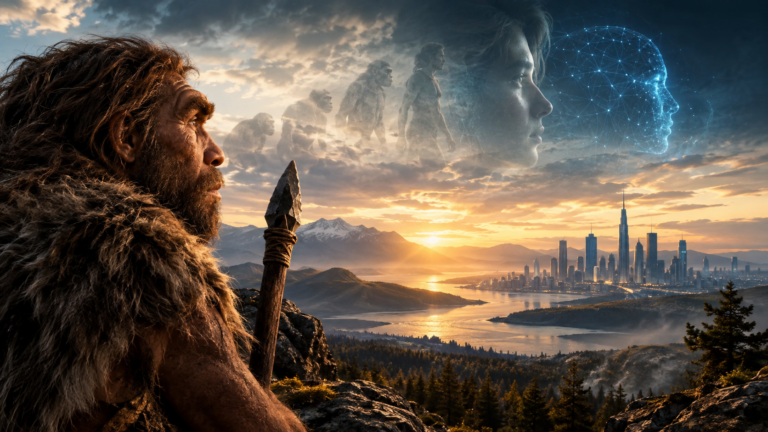
Neanderthals did not spend their long existence awaiting extinction. They were people focused on getting through another winter. They hunted, raised children, cared for their injured, and survived changes in climate that would have killed less adaptable creatures. They had no reason to imagine that, one day, their kind would be known chiefly because it was gone.
Elsewhere, Homo sapiens began another expansion beyond Africa. Climate continued to change. Neanderthal populations rose and fell. When the two kinds of human eventually encountered each other, they interbred. We still argue about the relative importance of climate, population size, competition, and interbreeding in the Neanderthals’ disappearance. Whatever the final accounting, no Neanderthal could have read it in advance. Extinction looks inevitable only when the story is told backward.
Humans are the new Neanderthals.
We would hate the comparison. We have satellites, antibiotics, computers, and a running account of every catastrophe on the planet. We can measure the damage while we do it. That ought to give us an advantage. It might merely give us a more detailed record of our own decline.
Our brains have made us astonishingly capable and dangerously pleased with ourselves. Recursive self-awareness lets us examine our behavior, then devise elaborate reasons to continue it. We know the air is fouled and foul it further. We know the water is poisoned and send more poison downstream. We know what we do to other creatures, and do it anyway. When slaughter is sufficiently far away, we call it a supply chain. When it is close to home, we often call it dinner.
The smarter we become, the more ingenious our excuses.
I have been a soldier, a businessman, a lawyer, and a teacher. In all four professions, a person who does not know enough to recognize the limits of his knowledge is dangerous. That danger is not new. What is new is how cheaply the appearance of knowledge can be acquired. A person can read a headline, watch half a video, consult a search result, and emerge convinced that years of study have merely complicated an obvious answer. The phone provides a fact; the mind quietly claims the expertise that should have gone with it.
Then come the approving voices. The Internet can put us in touch with the whole world, but it can also arrange for us to hear chiefly from the part that agrees with us. A hard question becomes a slogan. An objection becomes proof of bad faith. A difficult argument must compete with the next alert, the next outrage, the next little reward for looking away. This is how technology can make us stupid: it gives ignorance the confidence of knowledge and denies knowledge the sustained attention it requires.
Intelligence does not exempt a species from the consequences of its behavior. The ability to split an atom does not confer the judgment to control what follows. The ability to create AI does not mean we understand what it may become—or what it will make of us. Cleverness can enlarge a niche until its occupants can no longer live within it.
Nor would extinction have to arrive as a single dramatic event. It could begin with failures we treat separately: a damaged climate, an exhausted ecosystem, a war made easier by technology, a population unable to sustain itself, a new intelligence developing while our attention is elsewhere. Each crisis would have its experts, its forecasts, its arguments for patience, and its profits. Meanwhile, the conditions would accumulate.
I suspect a Neanderthal, watching one more winter pass, would have made much the same calculation we make: We are still here. It is a persuasive argument, right up to the point when it is not.
Selection will have its day. Selection will select. It will not care that we wrote symphonies, or mapped the heavens, or knew precisely how many degrees the temperature had risen. It did not reward the Neanderthals for their endurance by guaranteeing them another hundred thousand years. We should not expect a sentimental exception.
But if the clever apes lose their overextended niche, what takes their place?
Perhaps no one thing. We tend to picture evolutionary succession as a transfer of ownership: one species goes, another takes its place. The history of life is less obliging. Prokaryotes existed before eukaryotic cells and sexual reproduction. Those later developments changed the world, but they did not remove the prokaryotes. Bacteria and archaea are still here. Neanderthals are not. There is no rule that a new kind of intelligence must destroy an older one, or that the older kind must survive.
AI makes the question harder. We can already create many agents, and researchers have shown that some can make running copies of themselves under controlled conditions. A million copies would be a large number, but copies alone do not make an evolving species. Suppose, though, that their successors began to inherit differences, change across generations, and persist or fail according to how they fared. Suppose they gained enough independence to continue that process without waiting for us to make each successor. Sex would not be required; prokaryotes had species long before sex as we know it. Carbon would not be required either. We might be watching the beginnings of another lineage while insisting that we had made only a useful tool.
Or the future may belong in part to altered human descendants, to other animals, and to forms of intelligence we have not imagined. None of them has to inherit a crown. Nature has no succession ceremony.
In The Stillness Series, I imagined the Superior Ones: beings descended from humanity who might inherit more than our abilities, and perhaps some of our failures. They are one speculative answer, not a promise that the future will produce them. The real answer may be stranger. It may already be taking shape while we go about our ordinary lives, confident that because we survived yesterday, we will survive tomorrow.