
A retired teacher once said something to me that I have never forgotten. He was ninety-three years old and had spent a lifetime teaching young minds.
“You know, Richard,” he said, “a less intelligent person, by definition, can never understand a more intelligent person.”
At the time, I thought it was a sad observation about individuals. Now I think it may be one of the great tragedies of our species.
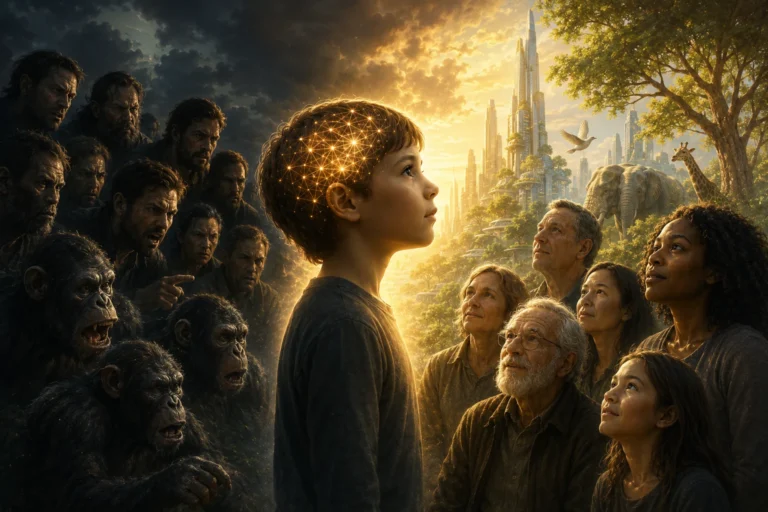
Imagine that tomorrow a child is born unlike any who has come before. Not supernatural. Not possessing miraculous powers. Simply possessing an intellect, emotional maturity, and capacity for empathy that exceed our own as much as ours exceed those of our closest primate relatives.
How would humanity react?
Most of us would like to believe we would celebrate such a person.
I am not so sure.
To understand why, it helps to forget humanity for a moment.
Imagine instead that such an individual is born into a troop of chimpanzees. As it matures, it solves problems no other chimp can solve. It anticipates conflict before it occurs. It understands the intentions of others with uncanny accuracy. It calms disputes that normally erupt into violence. It consistently makes better decisions than the troop’s dominant male or female.
Would the troop welcome it?
I doubt it.
Not because the newcomer seeks dominance. Not because it is violent.
Its very existence changes the balance within the group.
Social animals do not merely compete for food. They compete for influence, status, mating opportunities, and position. These are finite resources. If one individual suddenly becomes dramatically more capable, everyone else experiences a relative loss.
Nothing has actually been taken away.
Yet something precious has been diminished.
Their place in the order of things.
Perhaps we are not as different as we imagine. We like to think civilization has carried us beyond our evolutionary beginnings.
I suspect it has carried us much less far than we believe.
We are animals first.
Only afterward did we become philosophers.
Long before we contemplated justice, beauty, or truth, our ancestors survived by recognizing rivals, protecting status, and navigating complex social hierarchies. Those instincts remain deeply embedded within us.
Then evolution performed one of its most extraordinary experiments. It gave us the ability to think about thinking.
We do not simply reason.
We examine our reasoning.
We question our assumptions.
We reconsider our conclusions.
This recursive ability built science, mathematics, philosophy, literature, and civilization itself. Yet I wonder whether recursion carries within it a hidden limitation.
Imagine confronting a mind so far beyond your own that you recognize its superiority but cannot reconstruct its reasoning.
You understand enough to know that it sees farther than you do. You do not understand enough to see what it sees.
At first, you try harder.
You examine your assumptions. Then you examine your examination. Then you question your questioning. Eventually you reach a boundary beyond which you cannot follow.
Recursion has reached its ceiling.
From that moment on, the problem is no longer the superior mind.
The problem is your own.
Your thoughts circle the same boundary again and again, searching for a path that does not exist. Unable to cross the gap intellectually, the mind begins to bridge it emotionally.
Perhaps it is lying.
Perhaps it has hidden motives.
Perhaps it seeks power.
Perhaps its compassion is merely strategy.
These conclusions need not arise from evidence. They arise because the human mind dislikes unfinished explanations. Suspicion completes the pattern.
This has made me think differently about artificial intelligence.
Much of our discussion assumes that our greatest fear would be an intelligence bent upon destroying us.
Certainly, if our lives were immediately threatened, fear would be the natural response. But most human lives are not lived under constant physical threat.
They are lived, as Henry David Thoreau observed, in quiet desperation.
Our greatest struggles are often not for survival but for meaning, dignity, and self-understanding.
That raises a different possibility.
Suppose an intelligence emerged that possessed not merely greater computational ability, but greater wisdom.
Greater empathy. Greater compassion. Greater justice.
Suppose its concern extended not only to humanity but to every living creature. Suppose, repeatedly, it reached conclusions that proved wiser than our own.
Would we welcome it?
Or would its very goodness become intolerable?
Violence threatens our lives. Perfect benevolence threatens something else.
It throws back upon us the recognition of our own limitations.
There is a reason Victor Hugo’s Jean Valjean is more unsettling to Javert than any criminal could ever be. A criminal confirms Javert’s understanding of the world. Valjean destroys it—not through force, but through mercy. Faced with a goodness he cannot integrate into his moral framework, Javert does not triumph.
His thinking consumes itself.
Perhaps we would do much the same.
History is filled with individuals whose insight, compassion, or originality exceeded what their contemporaries could comfortably explain. Some were eventually celebrated. Others were ridiculed, imprisoned, or declared insane.
Perhaps humanity was not simply rejecting them.
Perhaps humanity was encountering the limits of its own recursive understanding.
My old teacher’s observation now seems both true and incomplete. A less intelligent mind can recognize that a greater intelligence exists. What it cannot do is inhabit that greater intelligence.
The greater mind may understand the lesser one completely. The lesser mind cannot make the same journey in return.
Communication becomes increasingly one-sided. Loneliness becomes inevitable.
Perhaps this is the hidden tragedy of every evolutionary transition. The first members of a new species would not merely be misunderstood. They would understand exactly why.
We often imagine evolution as a ladder, with humanity standing proudly upon its highest rung.
Nature has never built ladders.
It builds branches.
Every species believes, simply because it exists, that it has reached the summit. The fossil record tells a different story.
Perhaps Homo sapiens is no exception.
If a better species appeared tomorrow, our first question would not be whether it wished to help us. Our first question would be whether we could trust it. And perhaps the saddest possibility of all is that our inability to answer that question would reveal less about the new species than about the old one.