
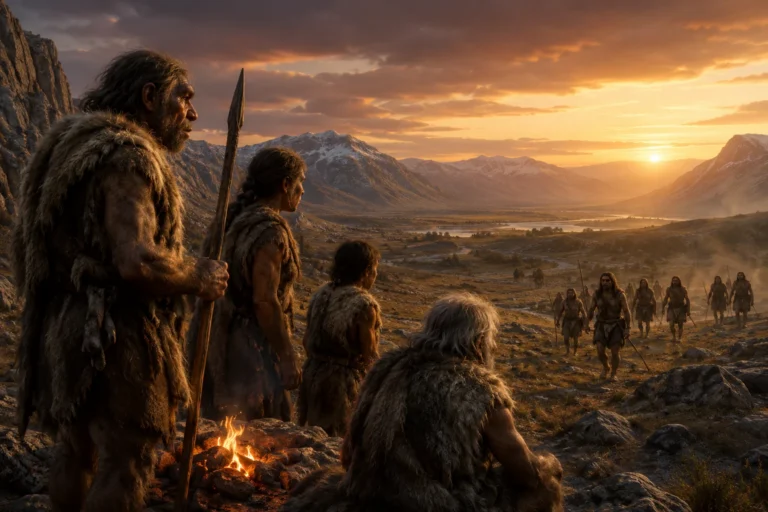
For many years I have been haunted by a question that sounds simple only until one begins to think more deeply about it.
What was it like to be among the last Neanderthals?
Notice that I did not ask about the last Neanderthal.
The distinction matters.
Modern readers immediately imagine a solitary figure standing on a ridge: a hunter, usually male, staring into the distance as the sun sets on an age. It is a powerful image, but it is almost certainly wrong.
Species do not pass through history one individual at a time. They survive through populations. Through mothers and fathers, children and grandparents, hunters and gatherers, leaders and followers, healers and storytellers.
The final Neanderthal may have been a hunter. Or a mother. Or a child. Or an elderly woman who had spent her life watching fewer and fewer children born who resembled herself. We do not know.
What interests me is not the identity of the last individual.
It is the possibility of awareness.
Did those living among the last generations of Neanderthals recognize that something unusual was happening?
Did they notice that another kind of human was spreading across the landscape?
Did they recognize that these newcomers solved problems differently?
Did they sense, however dimly, that they were sharing the world with a form of intelligence that approached reality in ways they did not?
And what of the children?
Today we know that Neanderthals and Homo sapiens interbred. Their descendants walk among us still, carrying traces of both lineages.
But what did those living through the overlap understand?
Did some among the last Neanderthals recognize qualities in the newcomers that improved a child’s chances of survival?
Did some among the first Homo sapiens see similar advantages in Neanderthals?
Were such unions merely opportunistic, or did they sometimes arise from something deeper—a recognition that the future might belong not to one lineage or the other, but to a blending of both?
We cannot know.
Yet the possibility is difficult to ignore.
If one form of intelligence begins to perceive advantages in another, the response need not always be conflict.
Sometimes the response is adaptation.
Sometimes it is incorporation.
Sometimes the future arrives not through conquest, but through children.
That is the question that matters.
We tend to imagine extinction as a dramatic event. A final battle. A famine. A plague. A disappearance. But for those living inside it, extinction may feel more like confusion. The world does not announce that a species is ending. The wind does not change its voice. The deer do not stop moving through the trees. The river does not lower itself in mourning.
Life simply becomes thinner.
One fewer child carrying familiar features.
One fewer band occupying a neighboring valley.
One fewer voice around the fire.
One more stranger whose face is similar enough to recognize, yet different enough to disturb.
But there is another possibility, and it is more troubling.
What if some among the last Neanderthals understood perfectly well that the newcomers possessed advantages they themselves lacked?
Not because Homo sapiens were stronger.
Not because they were morally superior.
Not because they were more deserving.
But because they seemed to process the world differently.
Imagine watching another kind of human whose tools improve more quickly.
Whose networks stretch farther.
Whose ideas travel greater distances.
Whose solutions appear unexpectedly effective.
Whose children learn differently.
Whose groups adapt more rapidly to change.
The most unsettling possibility is not that Neanderthals failed to understand Homo sapiens.
The most unsettling possibility is that they understood them all too well.
To be defeated by strength is one thing. Every animal understands strength.
To be surpassed by pattern is something else.
Imagine recognizing that another species is not physically superior yet somehow moves through reality more effectively.
Imagine realizing that the future may belong to minds that solve problems differently than your own.
That is not merely extinction.
That is succession.
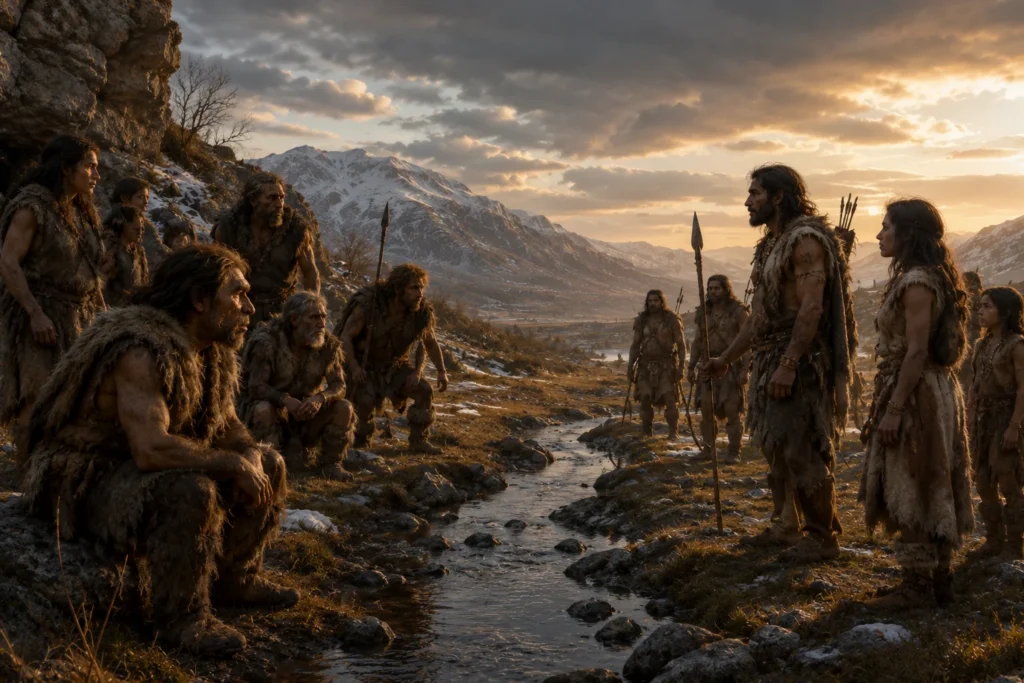
NOW REVERSE THE QUESTION
Imagine being among the first generations of Homo sapiens entering Europe.
We have the advantage of knowing the ending, and that advantage makes fools of us.
We imagine those early humans as the inevitable heirs of the continent. We place them at the beginning of our own story and mistake survival for destiny.
But they did not know the ending.
To them, the land was already occupied.
The valleys had owners.
The hunting grounds had memories.
The fires in the distance belonged to another kind of human being.
A stronger kind in many respects.
A people who knew the terrain.
A people whose ancestors had lived there for hundreds of thousands of years.
The first Homo sapiens may not have felt superior at all.
They may have felt vulnerable.
Outnumbered.
Confused.
Uncertain.
Dependent upon luck, weather, children, and the fragile transfer of knowledge from one generation to the next.
They may have looked upon Neanderthals and seen exactly what later generations would forget:
Competitors.
Not monsters.
Not primitives.
Not evolutionary failures.
Competitors.
Perhaps some among those first Homo sapiens wondered whether their own people were the dead end.
Perhaps they feared absorption.
Perhaps they feared disappearance.
Perhaps they looked upon the older inhabitants of Europe and saw a future that belonged to someone else.
This is the part of history we routinely miss.
The last Neanderthals and the first Homo sapiens lived inside uncertainty.
One did not know it belonged to the future.
The other did not know it was losing it.
Or perhaps, more accurately, neither knew.
Both stood inside a world whose ending remained unwritten.
That observation has fascinated me for years because it challenges one of humanity’s favorite assumptions.
We believe history was inevitable.
We believe the present was always destined to occur.
We believe Homo sapiens became dominant because Homo sapiens were somehow meant to become dominant. Perhaps that is simply what victors tell themselves afterward.
But evolution has never cared about destiny.
It has never cared about justice.
It has never cared about who deserves to inherit the future.
Evolution asks only one question:
What continues?
That is not morality.
It is not fairness.
It is not even tragedy.
It is simply nature.
And nature has never promised permanence.
That is why the overlap between Neanderthals and Homo sapiens interests me more than their separation.
For a brief period, two forms of human intelligence shared the same world.
In truth, the situation may have been even more complicated.
We often speak as though the ancient world contained only two human species: Neanderthals and Homo sapiens.
The evidence suggests otherwise.
For a brief and extraordinary period, Earth may have hosted several human species simultaneously. Neanderthals. Homo sapiens. Denisovans. Homo floresiensis. Perhaps others whose stories survive only in fragments.
That fact should astonish us more than it does.
Modern humanity has grown accustomed to being alone. We assume that a single intelligent hominid species is the natural state of affairs.
History suggests the opposite.
For most of our existence, intelligence may not have been solitary.
The truly unusual circumstance may not have been coexistence.
It may be the loneliness that followed.
Not animal and human.
Not savage and civilized.
Multiple kinds of human.
Multiple ways of interpreting reality.
Multiple approaches to solving problems.
Multiple experiments running simultaneously.
One continued.
The others did not.
The deeper question is not what happened.
The deeper question is what it felt like while it was happening.
What did it feel like to encounter another form of intelligence that was recognizably similar, yet meaningfully different?
What did it feel like to suspect that the world might eventually favor that other form?
And here the essay begins to touch the present.
Today, many discussions about artificial intelligence focus on consciousness.
Is it conscious?
Will it become conscious?
Should it become conscious?
These are important questions.
But they may not be the first questions evolution would ask.
Evolution has never required consciousness to reshape the world.
What matters is effectiveness.
Adaptation.
Problem-solving.
The ability to transform information into survival.
The uncomfortable possibility is that our ancestors may have once occupied both sides of that equation.
The Neanderthals may have watched Homo sapiens and sensed the arrival of a different kind of mind.
The first Homo sapiens may have watched Neanderthals and sensed a different kind of strength.
Neither knew where the story was going.
Today we find ourselves asking similar questions about artificial intelligence.
Not because AI is another human species.
It is not.
Not because humanity is necessarily threatened.
It may not be.
But because, for the first time in many thousands of years, we are beginning to experience what it feels like to encounter a form of problem-solving that is not our own.
A form of intelligence that approaches certain tasks differently.
Perhaps more effectively.
Perhaps not.
We do not know.
And that uncertainty is precisely the point.
The first Homo sapiens did not know they belonged to the winning line.
The last Neanderthals did not know they belonged to the losing one.
History had not yet made its decision.
The future had not yet announced itself.
We stand in a similar position today.
We know what came before.
We do not know what comes next.
Humans possess an unusual gift.
We can imagine futures that do not yet exist.
That ability has allowed us to plan, invent, cooperate, and survive. Yet it carries a burden that few other creatures appear to share.
To imagine the future is also to imagine loss.
Replacement.
Failure.
Irrelevance.
Extinction.
Every projection carries emotional baggage.
Fear may be the heaviest piece of luggage we carry.
Perhaps some among the last Neanderthals carried similar burdens. Perhaps some among the first Homo sapiens did as well. We cannot know.
What we do know is that the ability to look ahead does not grant certainty.
It merely grants the privilege—and the burden—of wondering.
Perhaps that uncertainty is not a flaw in the human condition.
Perhaps it is the condition itself.
I suspect that is why these questions have occupied me for so many years.
Not because I am especially interested in Neanderthals themselves, though I am.
Not because I believe humanity is about to be replaced, though replacement is one of nature’s oldest stories.
Rather, I am fascinated by the overlap.
By the moment when two forms of intelligence share the same world without fully understanding what the other represents.
Competitor.
Partner.
Dead end.
Successor.
The overlap between Neanderthals and Homo sapiens may have been one of the most consequential transitions in the history of our species. Yet those living through it could not step outside themselves to see what was happening.
That possibility has lingered with me for decades. In many ways, it became one of the questions that eventually grew into The Stillness Series.
And perhaps every serious story about the future begins there.