
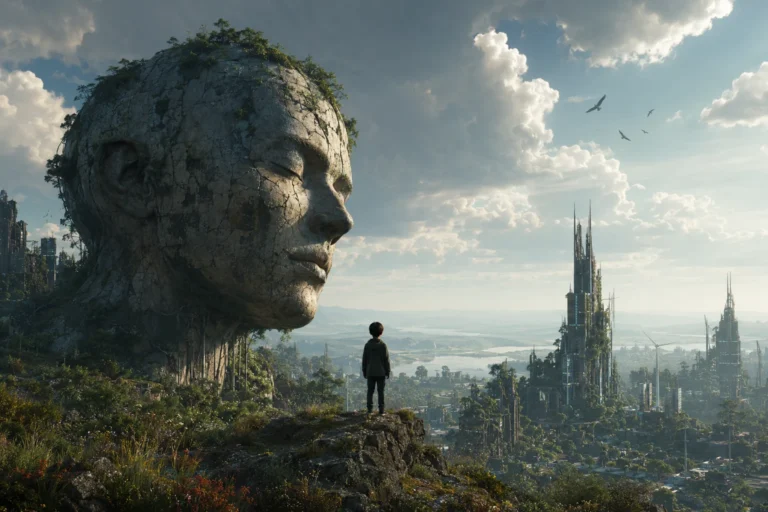
Modern civilization rests upon a quiet assumption:
that greater intelligence leads inevitably toward progress.
We rarely question this anymore. Intelligence gave us medicine, engineering, literature, music, philosophy, law, astronomy, flight, and computers. It placed human beings on the moon. It split the atom. It mapped the genome.
Surely evolution was moving somewhere.
Surely consciousness was the destination.
But what if it was not?
What if consciousness is only an experiment?
And what if it is failing?
That question sits underneath The Stillness Series, though it took me many years to recognize it clearly myself.
During the Vietnam War, I saw highly intelligent systems produce catastrophic outcomes with perfect bureaucratic logic. Later, in business and law, I saw equally intelligent people construct vast structures devoted to expansion, competition, and accumulation, often without asking where any of it ultimately led. As a teacher, I watched young people inherit technologies capable of instant communication across the planet while simultaneously becoming more isolated, anxious, and detached from the physical world around them.
None of this proved humanity was evil.
It suggested something more troubling.
Intelligence and wisdom may not be the same thing.
Of course, the moment one says words like intelligence, progress, wisdom, or even consciousness, the definitions begin slipping through the fingers.
We use these terms constantly, often with enormous confidence, yet pinning them down precisely becomes strangely difficult. The old Supreme Court observation about obscenity comes to mind: impossible to define clearly, but “I know it when I see it.”
Human beings clearly recognize intelligence in practice. We recognize wisdom too, though less consistently. We speak of progress almost automatically. Yet history complicates every definition.
Was the twentieth century progress? It gave us antibiotics and Auschwitz. Jet travel and industrialized slaughter. Nuclear power and nuclear weapons. Instant communication and loneliness on a planetary scale.
Even the natural world offers uncomfortable analogies. Progress for algae in a lake can mean rapid expansion, explosive success, and total domination of the environment. More growth. More consumption. More reproduction. From the algae’s perspective, the system is flourishing.
Until the lake dies.
Biologists call the process eutrophication. Excess nutrients trigger uncontrolled growth that eventually depletes oxygen, collapses balance, and destroys the larger ecosystem sustaining the bloom itself.
Nature often rewards short-term success long before consequences arrive.
Human civilizations may not be exempt from that pattern simply because we write symphonies and build computers.
Even consciousness itself resists easy definition. Is it self-awareness? Reflection? Memory? Language? Moral reasoning? The ability to suffer? To imagine the future? To know one will die?
No consensus exists.
And perhaps that uncertainty matters more than we admit.
A species unable to define its highest values with clarity may still pursue them with extraordinary force.
Evolution does not select for wisdom. It selects for survival and reproduction. If a species becomes more capable while also becoming more destructive, evolution may tolerate that imbalance for a very long time. Nature has no obligation to preserve what destabilizes its environment.
Human beings often speak about consciousness as though it were the final triumph of life on Earth. Ancient traditions were not always so certain.
The Greeks repeatedly warned about overreaching intellect. Daoist thinkers distrusted excessive abstraction and separation from the natural order. Buddhism questioned the solidity of the self altogether. Even the story of Eden treats knowledge with profound ambiguity.
Modern civilization largely discarded those warnings.
We built societies devoted to acceleration. More production. More growth. More stimulation. More information. More speed. More consumption. More self.
And now we inhabit a species that increasingly thinks about thinking about thinking, often losing contact with the physical and ecological realities beneath it.
The problem may not be thought itself.
The problem may be recursive consciousness without restraint.
A mind capable of reflecting upon itself indefinitely can become extraordinarily creative. It can also become unstable. Detached. Addicted to abstraction. Unable to stop expanding even when expansion becomes self-destructive.
That possibility became one of the foundations of The Stillness Series.
The books do not imagine humanity destroyed by invading aliens or killer machines. They explore a quieter and perhaps more unsettling possibility:
that Homo sapiens may represent a transitional species rather than a final one.
Not evil.
Not worthless.
Not condemned.
Simply incomplete.
In the series, the emergence of the Superior Ones is not presented as utopia. Evolution never grants gifts without consequences. Every adaptation creates new vulnerabilities. Every advance introduces new forms of instability.
But the central question remains:
What if the next step in evolution is not greater intelligence, but greater balance?
What if survival ultimately belongs not to the species that can dominate its environment most aggressively, but to the one capable of remaining psychologically and ecologically stable within it?
And perhaps the deepest uncertainty is this:
If humanity were someday replaced by a wiser, more balanced species, what else might disappear with us?
Cruelty has shaped much of human history, but so have courage, sacrifice, longing, tragic beauty, and the strange intensity born from mortality and limitation. Some of humanity’s greatest art emerged not from comfort, but from suffering, conflict, and impossible choices.
A perfectly stable species might also become something quieter. Safer. Less divided against itself.
But would it still produce an Iliad? A Beethoven symphony? A shattered soldier carrying Rousseau in his rucksack through a jungle war?
I do not ask those questions rhetorically.
I suspect they may be among the most important questions our species can ask itself.
This is usually the point where people ask whether such thoughts leave room for hope.
I think they do.
But hope for what?
For humanity exactly as it exists now? For industrial civilization? For the continuation of the individual self indefinitely? For technological immortality? For endless expansion into the stars?
Modern culture tends to bundle these together as though they were the same desire.
They are not.
Hope for one thing may require limits upon another.
A forest does not define hope the way an empire does. A coral reef does not measure success by perpetual growth. Most living systems survive through balance, restraint, adaptation, and cyclical renewal rather than endless accumulation.
Human beings, however, increasingly place their hope in permanent increase: longer life, greater consumption, infinite connectivity, limitless expansion, perhaps eventually even escape from death itself.
Yet nature has never offered immortality to complex systems. Not civilizations. Not species. Not stars. Galaxies themselves are temporary arrangements. Even the universe appears to carry mortality within its structure.
Everything participates in succession.
I sometimes think of Melville’s white whale.
Generations of readers have argued over what the whale “means,” as though it could be pinned neatly beneath glass. Nature. God. Fate. Evil. Obsession. The unknown.
But perhaps the whale endures precisely because it refuses reduction.
To me, the whale increasingly resembles humanity itself: immense, wounded, magnificent, dangerous, pursued across the oceans by its own kind.
Captain Ahab believes he hunts an external enemy. Yet the voyage gradually takes on the shape of a civilization harpooning something within itself. Not merely nature. Not merely mystery. Perhaps even its own better possibilities.
We are extraordinarily capable creatures. Brave. Creative. Curious. Compassionate.
And also restless beyond measure.
At times I wonder whether modern civilization resembles the Pequod racing forward under full sail, unable to distinguish conquest from self-destruction, hunting and killing the better angels of its own nature with harpoons.
That may sound bleak at first, particularly to modern ears. But perhaps there is another way to view it.
Perhaps meaning does not require permanence.
Perhaps consciousness was never meant to become an isolated throne standing outside nature, but a temporary bridge back into deeper forms of relationship: with other life, with limitation, with mortality, with the living world that produced us.
I do not know whether humanity will achieve that balance.
The honest answer is that none of us know.
But I suspect the future will belong not to the species that seeks to conquer reality completely, but to the one capable of living within it without destroying the very oceans from which it emerged.