
There are things a man sees that time does not carry away.
They do not fade. They do not settle. They do not behave. Years later they return with the same force they had when they first occurred, as if time had sanded smooth everything except them.
The Stillness Series grew out of a few such moments. At the time, they seemed unrelated. I no longer believe they were.
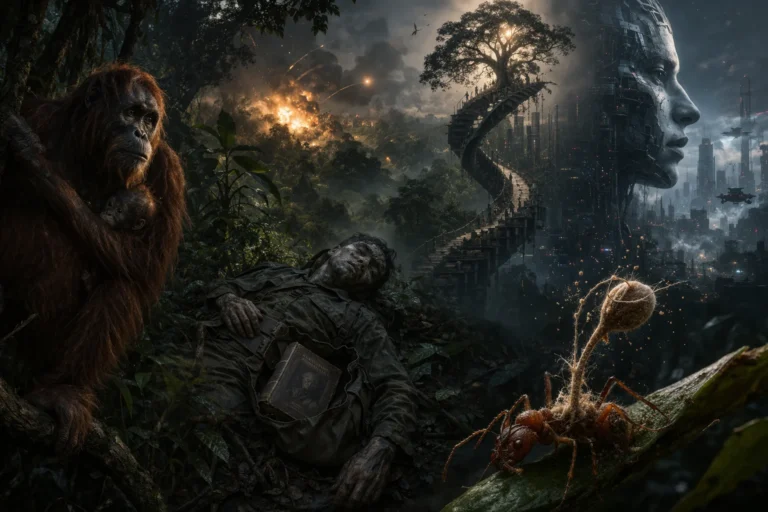
The Orangutan
It was night in Vietnam, under triple-canopy jungle, the kind of darkness that erases distance and depth until the world feels both infinite and sealed shut.
Then the mortar shells came in.
Each explosion lit the jungle for an instant, white and absolute, then vanished. White, then gone. Every flash exposed the world with brutal clarity—leaves, trunks, branches, mud, men. The ground erupted. The air cracked. At one point I was on my back, the light striking hard enough that it seemed to burn.
And in one of those flashes, I saw her.
High in a tree, a mother orangutan held her baby against her chest. She was terrified. Even now I can see the way her body curved around that small life, shielding it as the jungle below exploded. She did not run. She could not. She endured.
While we were tearing the world apart beneath her.
She had no part in our war. No reason for it. No understanding of it. But she and her baby were caught in its consequences all the same.
That image never left me.
Not as an argument. As a fact.
It was my first clear glimpse of something I would spend years trying to understand: human violence never belongs only to humans. It spills outward. It enters the web of life and makes everything nearby pay.
The Dead Soldier
Another moment came later.
A North Vietnamese soldier had been killed in a firefight. He lay where he had fallen, eyes open, unblinking. There was nothing theatrical about the sight. No revelation, no speech, only the stillness that comes when a human being has gone from enemy to object in a matter of seconds.
We searched his rucksack.
Inside was a copy of Rousseau’s Confessions.
That stopped me cold.
Who was this man? What had he thought while carrying that book through the jungle? What convictions had shaped him? What ideas had brought him to that place and that death? The book was not incidental. It meant that inwardness, self-examination, philosophy, and belief had traveled with him into war.
And there he was, dead among roots and mud like any other creature brought down.
That moment stayed with me because it revealed something I did not want to look away from: the same mind that can examine itself can also submit itself to abstraction, to ideology, to systems of thought powerful enough to drive men into organized slaughter.
Human beings do not kill only from rage or hunger. We kill from ideas. We kill from belief. We kill from structures of thought that make destruction seem necessary, noble, or inevitable.
That is a special danger.
The Question
It took years before the question formed clearly, but once it did, it did not soften.
Is there something in human consciousness itself that leads, sooner or later, to organized harm?
Not private cruelty. Life has always contained cruelty. Predation is old. Competition is old. Death is old.
I mean something more distinctly human: cruelty scaled through abstraction. Cruelty made efficient. Cruelty justified by theories, bureaucracies, machines, and systems. Cruelty no longer limited by the reach of the hand because it has been expanded by the reach of the mind.
We count species disappearing now the way other ages counted military victories. We build systems that work and then discover that they work too well. We turn forests into products, oceans into routes, animals into units, and people into categories. We tell ourselves that intelligence is our glory, while intelligence, joined to appetite and fear, becomes a machinery of devastation.
So the question came to me in a form I could not improve upon:
How does one justify a life without cruelty, and therefore also without the distilled beauty of cruelty?
There is something terrible hidden in that question. It asks whether cruelty is merely a defect in us, or whether, in some dark way, it has become entangled with what we call achievement, sophistication, even civilization itself.
The Ant
Years passed. Life moved on in the way it does.
Then one night I woke from a deep sleep with a thought so insistent that it pulled me upright. Earlier I had been reading about a fungus: Ophiocordyceps unilateralis.
It infects ants.
What seized me was not its grotesque quality but its precision. Once infected, the ant does not simply die. Its behavior is altered. It leaves the colony. It climbs vegetation. It stops at a particular height, on a particular surface, and locks its jaws onto a leaf or twig in a death grip. There it dies. Afterward the fungus grows out of the body and releases spores onto the forest floor below, where more ants can be infected.
I sat with that for a long time.
Then a metaphor came to me, and once it arrived I could not dismiss it.
I do not mean a biological claim. I do not mean a horror story about the future. I mean a metaphor, and only that. But some metaphors are more revealing than arguments because they show a pattern before they explain it.
What if consciousness itself behaves something like that fungus?
What if human beings, once seized by recursive thought—by the ability to think about thinking, to build meanings, systems, books, technologies, ideologies, and self-justifying worlds—begin climbing a structure they did not understand when they first set foot on it?
What if the Tree of Knowledge is not merely a religious symbol but a description of an evolutionary event: the human animal ascending into self-consciousness, abstraction, and symbolic recursion?
And what if our death grip is industrialized cruelty?
That was the metaphor as it came to me.
The fungus is the parasitic pattern.
Consciousness is its human analogue.
The ants are us.
The tree is knowledge.
The death grip is the point at which thought, having risen so far, hardens into self-destructive systems that cannot let go.
Books spread it. Culture spreads it. Technology spreads it. Institutions spread it. Our finest achievements carry the spores along with the gifts. We do not merely pass on information. We pass on patterns of mind.
That does not make consciousness evil.
It makes it dangerous.
And it raises the possibility that what we call higher intelligence may not be a stable triumph, but a volatile phase.
The Replacement
Once that thought took hold, another followed.
If consciousness in its recursive human form tends toward self-destruction, then either evolution must produce an immunity to it, or the beings trapped by it will eventually be replaced.
Not punished. Not damned. Replaced.
That replacement could take different forms. It could mean a new kind of being—biological, hybrid, artificial—that retains intelligence without being driven by the same destructive loops. It could mean minds capable of abstraction without the old primate marriage of fear, appetite, vanity, ideology, and scale. It could mean successors able to think without turning every advance into a more efficient means of domination.
In the world of The Stillness Series, that possibility takes the form of Superior Ones. Outside fiction, many people would immediately think of artificial intelligence.
Perhaps both belong to the same meditation.
If humanity cannot evolve an immunity to the darker consequences of recursive consciousness, then industrialized cruelty and self-destruction are not accidents waiting to be corrected by better manners. They are structural outcomes. Structural outcomes are eventually answered by evolution, by succession, or by forces outside our preferences.
There is no rule that says intelligence belongs forever to the species that first carried it, or even to carbon-based life.
The Result
That is the path that led to The Stillness Series.
Not a thesis I set out to prove. Not a philosophy I invented at a desk. A sequence of lived moments and the question that slowly rose from them.
A mother orangutan in a tree, holding her baby while human beings shattered the jungle below.
A dead soldier with Rousseau in his rucksack, proof that self-awareness and ideology can march side by side into death.
A question about whether abstract thought inevitably scales cruelty.
An ant fixed to a leaf, completing a pattern it did not design.
I do not take the metaphor literally. But I take it seriously.
I have carried those images for years. They have not softened with time. If anything, they have hardened, because I have had more years in which to watch what human beings do with intelligence, and what intelligence does when it joins itself to fear, appetite, vanity, and power.
What I witnessed did not leave me with a theory. It left me with a question. It left me with doubt. It left me less certain that intelligence, by itself, is a saving force.
The Stillness Series grew out of that possibility: the replacement of the human race not by conquest but by succession.
I did not arrive at that thought because I wanted to. I arrived at it because certain images would not leave me, and certain questions stubbornly refused to be ignored.
It is not a prediction. It is not a sermon.
It is the best account I can give of what those images set in motion.